
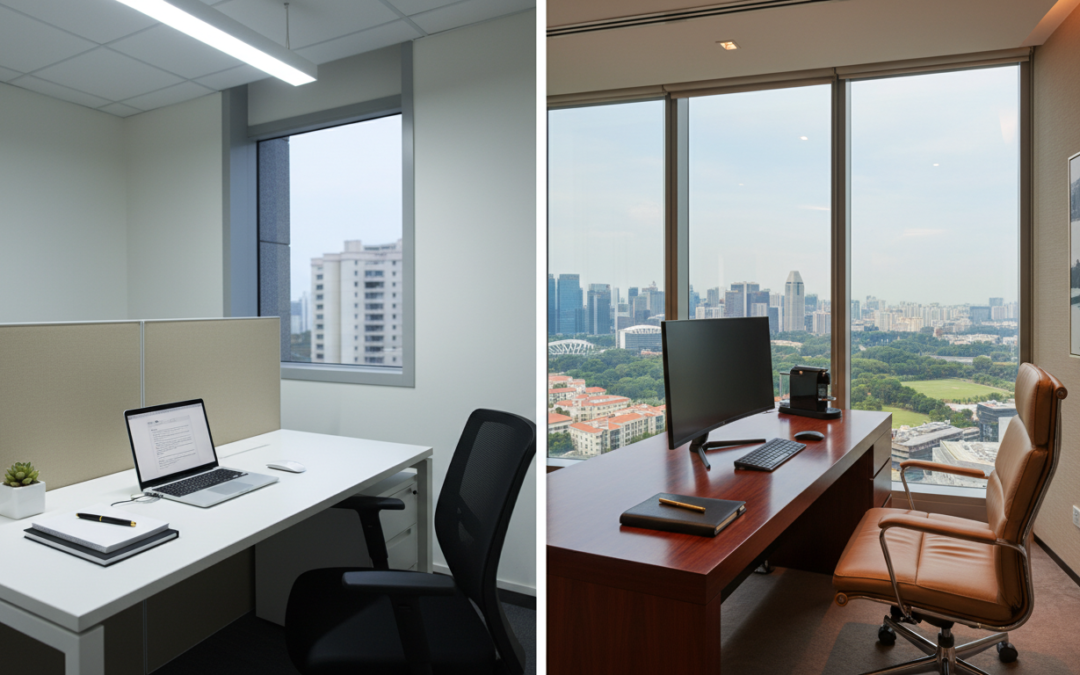
More than 70% of Singapore’s workforce now favours remote work, which has driven a surge in demand for address and support services. This shift makes the choice between a low-cost plan and a higher-tier package more consequential than ever.
Our goal is simple: help you pick by value, not by headline price. A basic plan from S$4/month can mask extra fees, while a bundled option at S$600/month may save time and bolster credibility.
Many small firms buy a compliance package and later find they need mail forwarding, meeting rooms or phone support. These add-ons change the true monthly cost and the practical value for startups, SMEs and international entrants.
This article will define labels, compare features, reveal the true monthly cost, and show how choices affect ACRA compliance and brand perception. You will leave with a like-for-like method to shortlist providers and choose confidently.
Key Takeaways
- Focus on total ongoing charges, not just the monthly headline fee.
- Basic plans suit compliance but often need paid add-ons later.
- Higher tiers can deliver measurable value for client-facing firms.
- Compare features step-by-step to create a fair shortlist.
- Consider credibility, mail handling and meeting access when choosing.
Why virtual offices are growing in Singapore right now
High fit-out costs and remote workflows push many companies to seek an official mailing address without leasing space.
Rising rents and fit-out expenses make a full premises a poor fit for lean teams. Many startups and small firms prefer a registered business address that keeps compliance costs low and avoids long leases.
The move to home and hybrid work has left a gap: staff do not need desks, yet firms still require a credible local presence, reliable mail handling and occasional meeting access.
A practical definition helps. A virtual office is primarily an address plus services such as mail processing and call answering. This differs from coworking: that model sells on-site desks and meeting rooms as the core product.
Some providers bundle address plans with coworking access. That overlap can justify higher fees when teams need occasional desks or client-facing spaces.
- Startups: compliance and credibility with low overhead.
- SMEs: balance between cost and client access.
- International companies: local presence without headcount.
| Feature | Address plan | Coworking access |
|---|---|---|
| Registered address | Included | Depends on package |
| Mail handling | Standard | Often available |
| Meeting rooms | Limited / pay-per-use | Regular access |
Next: the labels used by providers are shorthand. Understanding what you actually buy will make the “cheap” and “premium” tags meaningful.
Virtual office singapore cheap vs premium: what the labels really mean
Deciding between a low-cost plan and a full-service package comes down to what you need every day, not the sticker price. The basic offering usually covers registration and simple mail alerts. That fits businesses that receive little post and rarely host visitors.
“Cheap” as basic compliance and mail reception
Cheap plans typically include a business address, mail collection or notification, and minimal on-site staff. These packages suit sole traders and micro teams who prioritise compliance over client-facing polish.
“Premium” as bundled support, prestige locations and on-demand space
Premium packages bundle a high-profile location, live call answering, and easier access to meeting rooms or lounges. Providers such as Servcorp show how added support reduces friction and improves visitor handling.
When the cheapest option is not the most affordable
The false economy is real. Add-ons—mail forwarding, scanning, phone lines or hourly meeting rooms—raise monthly costs quickly. VOffice-style budget annual plans look cheap until those extras stack up.
Evaluate offers by workflow: mail volume, call frequency and client meetings. A higher fee can deliver fewer surprises, a stronger professional image and better responsiveness for time-sensitive matters.
| Feature | Budget package | Bundled package |
|---|---|---|
| Registered address | Included | Included (prestige) |
| Mail handling | Alerts / self-collection | Forwarding & scanning options |
| Phone support | None or pay-per-use | Live receptionist / call answering |
| Meeting rooms | Pay-per-use, limited | Priority access, included credits |
| Hidden costs risk | High | Lower (more bundled) |
Side-by-side comparison of what providers offer in Singapore
A direct comparison of features shows how each provider supports real workflows.
Business address and location prestige
Prestige matters for client perception. Providers such as Servcorp list CBD landmarks (MBFC, CapitaGreen, The Metropolis, Suntec Tower Three) that signal a high‑trust presence.
Fringe or suburban addresses, for example at Paya Lebar Square, serve compliance and cost‑sensitive use cases well. Choose an address based on expected client searches and brand positioning.
Mail handling, forwarding and scanning
Mail standards differ. SnapMail focuses on scanning and multiple collection points, while Straits notifies and forwards on request.
Look for: notification speed, secure storage, and whether scanning is optional or included. Per‑item forwarding fees can quickly increase monthly spend.
Phone services and receptionist support
Phone options range from basic voicemail to a live receptionist. Servcorp offers live answering and dedicated numbers; Davinci provides receptionist options with international support.
Assess whether calls are answered in your company name and if forwarding or voicemail is included under your plan.
Meeting rooms, boardrooms and private access
Regus gives wide location choice and app booking for rooms, but quality varies by centre. Straits rents rooms typically around S$20/hour; budget plans often require pay‑per‑use.
Check included hours, booking ease and whether the space suits investor or client meetings.
Admin, secretarial and IT support
Some providers bundle secretarial or corporate secretarial help—My Office is an example—while others offer ticketed IT support or on‑site staff for ad‑hoc tasks.
Decide if you need real‑time human support or a lower‑cost ticket system when building a like‑for‑like comparison.
| Feature | Typical budget provider | Typical bundled provider | Notes |
|---|---|---|---|
| Address prestige | Suburban / mail point | CBD landmark | Impacts credibility and search results |
| Mail handling | Alerts / self‑collect | Forwarding & scanning | Check per‑item fees |
| Phone support | Voicemail / pay‑per‑call | Live receptionist / dedicated number | Answering script affects brand |
| Meeting room access | Pay‑as‑you‑go | Included credits / priority booking | Essential for client meetings |
To compare providers offer fairly, build a spreadsheet listing address, mail handling, phone, meeting access and admin support. Use total monthly cost for each row and flag add‑on charges.
Learn more about registered address options when shortlisting providers.
The true monthly cost: package fees vs add-ons and hidden charges
Price bands in the market reflect location, staffing and what is bundled with each package.
Entry plans can start from about S$3.99–S$6 per month on long annual terms. Mid‑tier packages sit around S$80–S$128 per month, while full bundles can reach S$600/month for prestige addresses and extensive support.
Why prices spread so far
Location matters: CBD addresses cost more and affect client perception.
Staffing and live reception raise recurring payroll costs. Bundled amenities — phone, meeting rooms and admin help — also lift the headline fee.
Common extras that inflate the final bill
Mail forwarding is often charged per item or via prepaid credits. Scanning and storage add further fees.
Phone extras include per‑minute call forwarding, extra numbers and live receptionist upgrades. After‑hours handling is usually an add‑on.
Meeting rooms may be offered as included hours or billed hourly; AV and peak‑time surcharges increase expense.
Contract length and flexibility
Annual billing often reduces monthly cost but limits flexibility. Month‑to‑month plans cost more but suit fast‑changing firms.
Upgrade and downgrade terms matter. Check pro‑rata adjustments, notice periods and whether credits carry over.
Estimate total cost of ownership
- Estimate monthly mail items, calls and meeting hours.
- Pick a base package and list included services.
- Price expected add‑ons (forwarding, scanning, call minutes, room hours).
- Sum package + add‑ons and compare across providers on a monthly basis.
| Cost element | Typical budget band | Typical mid / bundled band | Notes |
|---|---|---|---|
| Headline package fee | S$4–S$6 / month (annual) | S$80–S$128 / month | Depends on address and included services |
| Mail forwarding & scanning | S$2–S$10 per item | Often included or discounted | Prepaid credits reduce per‑item cost |
| Phone services | Voicemail or pay‑per‑call | Dedicated number & receptionist | After‑hours and forwarding raise costs |
| Meeting rooms | Pay‑as‑you‑go (S$15–S$40/hour) | Included credits / lower hourly rate | Peak hours and AV add fees |
| Contract flexibility | Limited; often annual | Monthly options available | Flexibility often priced into the plan |
Professional image and client trust: does premium deliver a real advantage?
A recognised CBD business address can fast‑track trust during procurement and partner checks for higher‑value contracts. For B2B sellers and regulated firms, location signals reduce friction and speed decisions.
How a CBD address influences credibility and conversion
A landmark address on proposals and your website gives immediate credibility. Procurement teams often flag suburban listings as higher risk.
Result: fewer verification hurdles and improved conversion for client meetings and tenders.
What clients and partners see when they search your registered address
Search results reveal building name, neighbourhood and reviews. A staffed business centre reads as a stable presence; a postcode with no listings raises questions.
Why call answering quality can matter more than price
A trained receptionist answering in your company name builds trust. Missed calls or generic voicemail can lose leads before a proposal is read.
- When it matters: regulated sectors, fundraising, enterprise and cross‑border deals.
- When it matters less: micro online sellers with minimal inbound calls.
Note: credibility complements compliance. Your address must meet ACRA rules and serve as a genuine, commercial presence.
For easy client meetings, consider providers that include meeting room credits or simple hourly access via a dedicated booking page like meeting room rental.
ACRA requirements for a registered office address in Singapore
ACRA sets clear rules for registered addresses that directly affect which provider you can use. These rules matter because registration depends on a compliant address and reliable receipt of government mail.
Physical address rules and public accessibility expectations
ACRA requires a physical address — a P.O. Box is not acceptable. The address must be capable of receiving official correspondence and does not have to be where your day‑to‑day operations occur.
The address must be open to the public for at least three hours during normal business days. That implies the centre should have staffed hours, a visitor sign‑in, or a reception desk to demonstrate access.
Receiving official mail and what “compliant mail handling” involves
Compliant mail handling means secure receipt, prompt notification, a clear logging system, and reliable forwarding or collection arrangements for government letters.
Providers should escalate urgent government correspondence and provide proof of delivery or collection when requested. This reduces the risk of missed deadlines or penalties.
How to check if a provider is suitable for a registered business
Before you pay, verify key items with the provider. Ask directly about staffed hours, visitor handling, mail logging and escalation procedures.
- Staffed hours and public access windows
- How incoming mail is logged and notified
- Escalation process for government correspondence
- Service level agreements (SLAs) for notifications and forwarding
Practical checklist
- Confirm the address is physical and not a P.O. Box.
- Request written details of staffed hours and visitor policy.
- Ask how official mail is handled, logged and escalated.
- Check SLAs and whether annual plans limit access or collection times.
Why this matters: missed official mail can lead to penalties, interruption of registration, or reputational harm. Verify suitability before committing, especially on low‑cost annual plans that may restrict access.
| Check | Why it matters | Ask the provider |
|---|---|---|
| Physical address | ACRA compliance | Is this a street address (not P.O. Box)? |
| Public access hours | Meets three‑hour rule | What are your staffed hours and visitor procedures? |
| Mail logging & escalation | Prevents missed notices | How do you notify and escalate government mail? |
Provider snapshots: cheap virtual office packages in Singapore
If your key requirement is secure receipt and quick notification of letters, mail-centric plans merit close inspection.
VOffice — low-cost registered address
What you get: a business address, email alerts and self-collection for about S$57/year (≈S$4.75/month) on annual billing.
What’s missing: live receptionist, included meeting hours and free forwarding beyond optional credits.
SnapMail-style mail-focused options
These providers prioritise scanning, forwarding and multiple collection points. Plans start near S$6/month on long commitments and scale up for letters and parcels.
They often offer quotas, per-item forwarding fees and a 30-day money-back guarantee.
- Trade-off: self-collection saves money but costs time and is awkward if you travel often.
- Location: suburban addresses suit many businesses but may not impress high-value clients.
- Right-fit: sole traders, online-first sellers, early-stage testing and low-call companies.
| Provider type | Key feature | Typical price |
|---|---|---|
| Low-cost address | Registered address + alerts | ≈S$4.75/month (annual) |
| Mail-centric | Scanning, forwarding, multiple pick-up points | From ≈S$6/month |
| Budget trade-off | Time cost and add-on fees | Can erase savings if needs grow |
Caution: a budget plan works best when workflows are truly simple. Otherwise, add-ons for forwarding, scanning and room hire can quickly remove the cost advantage.
Provider snapshots: premium and mid-tier virtual office providers
Compare a handful of well-known providers to see how addresses, staffed reception and add-on access change daily operations.
Servcorp — prestige, staffed reception and lounge access
What you pay for: landmark addresses (MBFC, CapitaGreen, The Metropolis, Suntec Tower Three), live receptionist, dedicated phone number and reliable mail handling.
Why it matters: this package supports client‑facing credibility and reduces friction during procurement and investor checks.
Regus — broad locations and app-managed access
From around S$80/month, Regus gives wide coverage across 20+ centres and mobile booking for meeting rooms and coworking access.
Caveat: service consistency varies by centre; check reviews for the specific location you plan to use.
Straits Virtual Office — Suntec City as a pragmatic middle ground
With plans from S$12.99/month (annual), higher tiers add a dedicated phone line and call forwarding.
Meeting rooms are typically rented at about S$20/hour, and practical add-ons include scanning and cheque deposit.
Davinci — networked addresses for international companies
Davinci offers multiple local addresses, mail forwarding and receptionist options at roughly US$60/month.
Note: useful when you want a consistent presence across markets; consider time‑zone impacts on live support.
“Choose based on the services you need bundled, not the sticker price; credible reception and reliable mail handling save time and surprise costs.”
| Provider | Starting price | Key features | Best for |
|---|---|---|---|
| Servcorp | ≈S$115–S$128/month | Prestige addresses, live receptionist, lounge access | Client‑facing firms, tenders |
| Regus | ≈S$80/month | Wide locations, app booking, meeting rooms | Mobile teams, flexible access |
| Straits | ≈S$12.99/month (annual) | Suntec City address, optional phone, pay‑per‑use rooms | Cost‑conscious companies needing a CBD presence |
| Davinci | ≈US$60/month (~S$80) | International addresses, forwarding, receptionist options | Companies needing cross‑border consistency |
Shortlist providers by comparing included services, meeting room access and realistic add‑on costs. That keeps the total monthly cost clear.
How to choose the right virtual office package for your business needs
Start by matching an address to the expectations your clients hold for professionalism and trust. Pick a location that suits your industry: a CBD address helps in procurement-heavy sectors while a practical suburban address suits low-footfall e‑commerce businesses.
Choose the address based on clients, industry and brand positioning
Ask: will this address reassure clients or simply meet compliance? If you win work from corporates, a landmark address matters. If you trade online, cost and convenience may be more important.
Match services to your workflow: mail, calls and meeting frequency
Estimate monthly mail, call volume and how often you need meeting rooms. Choose a package that includes the right level of mail scanning/forwarding, phone answering and hourly room credits.
Assess provider reputation and service standards
Check reviews, longevity and response times. Verify call scripts, escalation for urgent mail and local support hours to ensure a company can handle ACRA notices and client enquiries promptly.
Decide on flexibility: month-to-month vs annual plans
Balance savings with agility. Annual terms reduce costs but tie you in. Month-to-month gives growth-stage companies room to pivot. Confirm upgrade, downgrade and cancellation terms in writing.
Build a like-for-like comparison using total cost, not headline price
Use a simple template: base fee + expected forwarding/scanning + phone/call charges + meeting room hours. Compare the summed monthly cost across providers and factor in scalability to private rooms if you plan to grow.
| Decision area | Key question | What to record |
|---|---|---|
| Address | Does it match client expectations? | CBD or suburban; perceived credibility |
| Services | Which mail, phone and meeting needs are core? | Scanning, forwarding, receptionist, room hours |
| Flexibility | Do you need short-term agility? | Monthly vs annual, upgrade/cancellation terms |
Conclusion
Match services and location to real needs, and you will find the best total monthly value.
Cost savings over leasing space are real, but only when a plan suits your mail, call and meeting workflows. Good providers bundle predictable services; others rely on add‑ons that raise costs quickly.
Keep compliance front of mind: pick a provider that meets ACRA rules and reliably receives official mail before you sign any packages.
When client trust matters, premium features such as a prestige address, live call answering and on‑demand meeting access deliver clear value. Budget plans win if needs are simple: low mail volume, few calls and no hosting of visitors.
Final step: shortlist two to three providers, request a full fee schedule (including add‑ons), and confirm staffed hours and mail handling. For practical tips on choosing a provider, see choosing a provider.
FAQ
What is the difference between a basic and a premium business address package?
Can I use a service address for ACRA registration and compliance?
How does mail handling and forwarding normally work?
Are meeting rooms and boardrooms included or charged separately?
How important is the physical location for client perception?
What phone services can I expect from providers?
Which extras should I watch for that raise the true monthly cost?
Is a low-cost package ever the better choice?
How do I compare providers fairly?
What contract terms should I look for?
Do providers offer additional admin or IT support?
Can international companies use these services for local presence?
How do I verify a provider’s reputation and service quality?
Are coworking access and lounge facilities common in mid-tier plans?
What should I consider about mail privacy and security?

Dean Cheong is a Singapore-based commercial growth architect and CEO of VOffice, known for helping B2B companies turn fragmented sales efforts into predictable revenue systems. He specializes in sales process optimisation, CRM-driven visibility, and market entry strategy, combining execution discipline with a strong academic grounding in business banking and finance from Nanyang Technological University. His focus is on building repeatable, data-backed growth frameworks that companies can scale with confidence.