
How much should a founder really budget to get started — and why does the headline figure rarely tell the full story?
This practical guide defines what the phrase singapore company registration fees breakdown means in practice. It covers not only ACRA filing but the full first-year cost to set up and stay compliant.
The government levy for incorporation is S$315 (S$15 name application + S$300 incorporation). Expect higher totals once essentials are added: a resident director, a company secretary, a registered address, banking support and ongoing compliance.
This short piece sets expectations for readers comparing DIY BizFile+ filing, corporate service providers and traditional firms. It also explains why local founders and foreign founders face different budgets due to resident director and work pass needs.
Outcome: you will gain an itemised checklist to request quotes and avoid hidden add-ons when planning initial cost and ongoing compliance.
Key Takeaways
- The headline government cost is S$315, but total first‑year cost is higher once essentials are included.
- This guide helps compare DIY filing, corporate service providers and traditional firms.
- Main cost buckets: government levy, mandatory roles, registered address, banking, ongoing compliance.
- Local and foreign founders face different budgets due to resident director and work‑pass needs.
- Use the article’s itemised checklist to obtain clear quotes and avoid hidden add‑ons.
Why “cheap” incorporation rarely reflects the real cost of starting a company in Singapore
The quoted S$315 covers only two items: the name application and the official company registration filing. That number is real, but it stops before the business is ready to trade.
What it does not include are mandatory post‑incorporation services such as a company secretary, a registered address, accounting setup, banking support and nominee director arrangements where needed.
How the process creates further costs
The practical steps—name reservation, filing, UEN issuance—are quick. Costs rise when you prepare to operate: bank account opening, statutory registers, and compliance systems all add expense.
Typical first‑year budgets
DIY filing can start from S$315. Market “all‑inclusive” packages often begin near S$650. If essentials are bought separately, first‑year totals commonly reach about S$2,000 for a local founder and roughly S$4,000 for a foreign founder.
Paying for many add‑ons à la carte can cost more than a bundled service. Value often means cost certainty and full compliance cover, not just the lowest upfront figure.
Government fees you must pay to ACRA for company registration
Before any service add‑ons, two government payments are required at defined stages of the online process. The name application is S$15 and is paid during name approval. The company registration filing is S$300 and is charged when you complete incorporation.
Name application fee and company registration fee
The company name must be approved before final registration. If the proposed name is rejected or needs edits, delays can push your timeline and add time‑sensitive costs.
Other common ACRA fees to plan for after incorporation
- Annual Return filing — S$60 per year.
- Conversion within company types — S$40.
- Notice of Error — S$60; registration of charges — S$60.
- Extension of time for AGM/accounts — S$200.
These government charges are fixed whether you use BizFile+ yourself or a service provider. Expect recurring ACRA amounts of roughly S$60–S$120 each year for routine filings and occasional transaction fees as the company evolves.
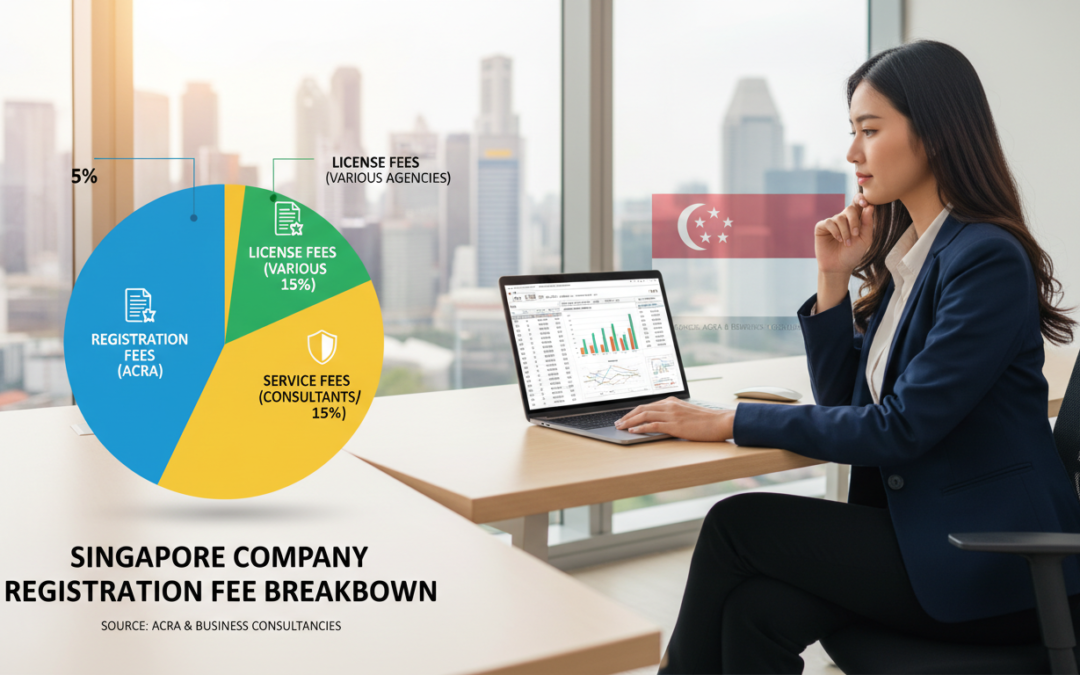
Note: Government fees are often the smallest slice of startup spend; most cost comes from operational services and compliance roles covered in the next section.
Singapore company registration fees breakdown: essentials most companies still need
Most new businesses need a short list of practical services to stay compliant from day one. These essentials are not part of the S$315 government charge but are effectively mandatory in practice. They drive the real first‑year cost and should be budgeted up front.
Company secretary appointment and typical costs
A qualified company secretary must be appointed within six months of incorporation. The secretary handles the compliance calendar, board resolutions and statutory filings. Market pricing varies by service level from about S$300–S$1,500 per year.
Registered address rules and what you buy
The registered address must be a physical local address, not a P.O. box, and reachable in business hours. Address services typically include mail handling, scans and forwarding. Expect S$100–S$500 per year depending on inclusions.
Resident director and nominee options
At least one director must be a local resident. Local founders can act as that director; foreign founders commonly engage a nominee director. This becomes a major cost driver for non‑residents.
Post‑incorporation documents and checklist
Typical deliverables: constitution, statutory registers, share certificates and initial resolutions. Ask providers to confirm in writing the secretary scope, address inclusions, director coverage, exact document set and any exclusions.
DIY BizFile+ vs corporate service providers vs traditional firms
Founders face three broad routes: handle ACRA filing yourself, buy a bundled digital service, or engage a conventional firm.
Cost comparison: ACRA-only filing versus bundled packages
DIY starts at S$315 and covers only the official filing. Digital bundled services often begin around S$650 and include an initial service package. Traditional firms typically quote from S$800 and commonly add extras.
What you handle yourself: paperwork, filings, and compliance risk
Doing it yourself means preparing BizFile+ forms, entering director and shareholder details and keeping statutory registers up to date.
Risk: missed deadlines or incorrect filing can bring penalties and extra remedial costs that erase any early savings.
What “all-inclusive” can include: secretary, address, banking support, and annual filings
All-inclusive packages should cover incorporation filing, one year of secretary service, a registered office address and Annual Return preparation. Many also offer bank account introductions and practical support for account opening.
Note that banks run independent KYC checks and may request further documents despite provider support.
- Best for solo founders with low transaction volumes: a basic bundled service.
- Multi-shareholder or cross-border setups: consider full support from a firm to reduce compliance work.
- If you need an office address or ongoing bookkeeping, factor those service costs into your selection.
Foreigner-specific cost drivers when incorporating a Singapore company
When a founder is based overseas, meeting the resident director requirement becomes the main cost driver. That typically means engaging a paid nominee director or arranging a local director relationship. These steps add both cost and ongoing administration.
Nominee director pricing and deposits
Nominee director services commonly range from S$2,000–S$5,000 per year. Pricing varies by risk appetite, included KYC, board attendance and contract scope.
Some providers ask for a refundable deposit to cover indemnity exposure or early termination. Ask for a clear scope and sample agreement before you sign.
Employment Pass fees and timing
Work pass applications cost government charges of S$105 at submission and S$225 on issuance, with typical processing around ten business days. Professional assistance may incur separate service charges.
Bank account support and likely charges
Bank support usually includes document preparation, appointment coordination and introductions. It helps with a smoother account opening but never guarantees approval.
Tip: prepare certified documents early and keep director/shareholder details consistent. If you need a virtual office or registered address, consider a trusted provider such as virtual office services to reduce KYC friction and speed months‑long steps in incorporation planning.
Ongoing compliance costs in Singapore to budget for each year
Budgeting for ongoing compliance matters as much as the initial setup; annual obligations create steady costs that founders must plan for.
Map these tasks into a simple calendar so deadlines do not surprise you. Annual Return filing to ACRA is a predictable S$60 charge each year. Other ACRA transactions may add occasional charges when you amend records or correct filings.
Accounting, tax and record-keeping
Accounting and tax are operating costs. Expect bookkeeping, preparation of financial statements and corporate tax filing to be recurring invoices.
Companies must keep supporting records for at least five years. Good systems reduce time and the risk of penalties.
Audit requirements and likely cost implications
An auditor must be appointed within three months unless exempted. Audit exemptions depend on size and turnover.
Audit complexity can move annual spend materially. Small exempt entities may avoid audit fees; larger or group structures face higher costs.
GST threshold and workload
GST registration becomes mandatory when taxable turnover exceeds S$1 million. Registered firms face quarterly returns and tighter invoicing controls.
Some businesses register voluntarily for commercial reasons, but this adds both administrative work and regular filing obligations.
| Obligation | Timing | Typical annual cost (S$) | Notes |
|---|---|---|---|
| Annual Return (ACRA) | Yearly | 60 | Fixed government charge; predictable |
| Accounting & tax filing | Quarterly/Annually | 1,500–3,500 | Depends on volume, bookkeeping quality |
| Audit (if required) | Annually | 1,000–5,000+ | Varies by size and complexity |
| GST compliance | Quarterly | 500–2,000 | Systems and invoicing overhead |
Plan an annual compliance budget. Many firms find total ongoing compliance costs land in the S$3,000–S$5,000 per year range when accounting and tax support are included. Treat these as core operating costs; investing in proper support is often cheaper than fixing late or incorrect filings.
How to choose the right incorporation package and avoid hidden fees
Decide on your target outcome first — speed to trade, minimal spend, or full support — and let that guide your choice.
Start by demanding an itemised quote. Insist the provider lists ACRA charges, name application, constitution, statutory registers, secretary scope, address scope and Annual Return support.
How to compare providers: what should be itemised in the quote
Ask if the quote covers bank introductions, number of board resolutions, paperwork reworks and nominee director limits. Get service turnaround times and renewal pricing in writing.
When a basic package is enough versus when full compliance support pays off
A basic package often suits a local founder with a single-shareholder structure and limited activity. It keeps initial cost low and speed high.
Full compliance support usually makes sense for foreign founders, multi-shareholder setups or groups that need nominee directors, work‑pass help or bank credibility.
Cost-minimisation tactics that don’t compromise compliance
Keep your structure simple initially and batch changes to reduce filing events. Clean records lower accounting and audit effort.
Before you sign, confirm whether the secretary is included for the full first year and what happens at renewal. Small clarifications avoid surprise charges.
| Item | What to check | Why it matters | Typical inclusion |
|---|---|---|---|
| ACRA & name | Explicit amounts for name application and incorporation | Prevents double billing | Usually included |
| Secretary & documents | Scope, number of changes, statutory registers delivered | Defines ongoing compliance | Often included for year one |
| Registered address | Mail handling, scan/forwarding, duration | Bank KYC and legal notices rely on it | Variable — verify scope |
| Banking & nominee | Introductions vs success fees; nominee limits | Major cost driver for non-residents | Often priced separately |
When you need a deeper cost guide, see a detailed breakdown at company incorporation cost guide. Use that to benchmark quotes and protect your cashflow.
Conclusion
Key takeaways, ACRA’s headline cost of S$315 starts the incorporation journey, but the real budget depends on mandatory roles, operational setup and ongoing compliance.
This guide helps you choose between DIY filing, bundled digital providers and traditional firms based on risk tolerance, internal capability and the need for predictable annual costs.
Essentials that shape most budgets are a company secretary within six months, a local registered address and at least one resident director — often a nominee for foreign founders. Factor in accounting, tax and any work‑pass needs.
Ask for itemised quotes, compare like‑for‑like inclusions, and build a first‑year budget plus an annual compliance plan. Use the article’s checklist and structure to pick a package that keeps your business compliant and ready to grow.
FAQ
What does the headline S5 incorporation price usually include and exclude?
Why is a low upfront incorporation cost often misleading for new businesses?
What government fees must be paid to ACRA during incorporation?
What other ACRA charges should I plan for after incorporation?
How much does appointing a company secretary typically cost each year?
What are typical charges for a registered office address service?
When do I need a nominee director and how much does that cost?
What post‑incorporation documents should I expect to receive or maintain?
How does filing via BizFile+ compare with using a corporate service provider or traditional law firm?
What costs are saved by DIY filing and what risks does it bring?
What does an “all‑inclusive” incorporation package normally include?
What extra costs do foreign founders typically face?
How are nominee director fees structured and why might a deposit be required?
What are typical costs and timelines for work pass applications like an Employment Pass?
What support and charges apply for opening a local bank account?
What recurring ACRA charges should be budgeted for each year?
What are the ongoing accounting, tax filing and record‑keeping obligations?
When is an audit required and what are likely costs?
How does GST registration affect compliance workload and costs?
What should I look for when comparing incorporation providers to avoid hidden charges?
When is a basic package sufficient and when is full compliance support necessary?
What practical cost‑saving tactics keep compliance intact?

Dean Cheong is a Singapore-based commercial growth architect and CEO of VOffice, known for helping B2B companies turn fragmented sales efforts into predictable revenue systems. He specializes in sales process optimisation, CRM-driven visibility, and market entry strategy, combining execution discipline with a strong academic grounding in business banking and finance from Nanyang Technological University. His focus is on building repeatable, data-backed growth frameworks that companies can scale with confidence.