
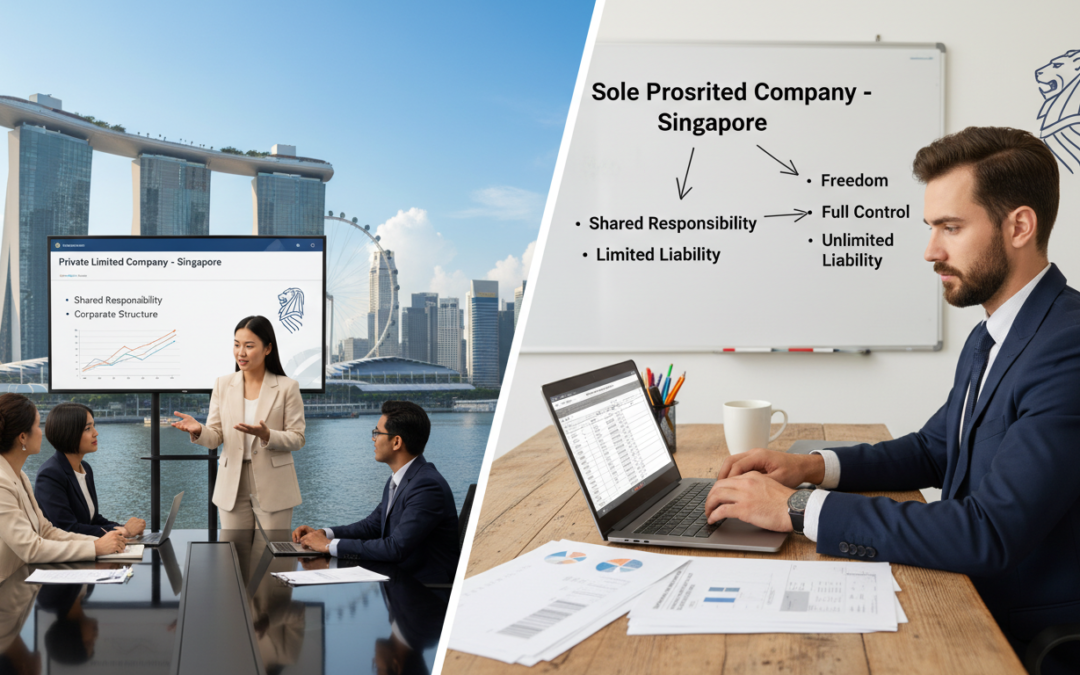
Nearly 40% of small firms change structure within five years because the initial choice can affect risk, tax and future growth in a big way.
If you run a one-person business, the easiest setup keeps things simple and cheap. That route gives no legal separation between owner and company. It suits low-risk trading or small freelance work.
Pte Ltd forms a separate company with limited liability. It costs more to run but protects personal assets and helps with credibility and funding. Many owners choose it to scale and attract investors.
This guide compares the two main options in plain terms and frames the decision around outcomes: personal risk, tax effects, credibility, operating cost and long-term returns. It will cover definitions, key differences, taxation, compliance, funding, BizFile+ registration and how to convert a sole proprietorship to a Pte Ltd.
We keep a professional, advisory tone. This is informational, not formal legal or tax advice. Rules and specifics may change, so check current ACRA and IRAS guidance for your situation.
Key Takeaways
- Choosing the right structure affects personal liability and future funding.
- A sole proprietorship is simple and low-cost but offers no legal separation.
- Pte Ltd grants limited liability and stronger long-term advantages for growth.
- Consider tax, compliance and credibility when deciding now to avoid costly changes later.
- Conversion paths exist; check BizFile+ steps and current ACRA/IRAS rules.
Sole proprietorship and Pte Ltd in Singapore: the quick overview
Choosing the right legal form shapes who pays for losses, how you pay tax and how fast the business can grow.
This rapid compare-and-contrast helps you see the key differences before diving deeper. One option means the business is not a separate legal entity from its owner. The other creates a separate legal entity with distinct rights and obligations.
Why the distinction matters: When debts arise, contracts fail or claims are made, the legal status decides whether personal assets can be targeted. It also affects how banks, investors and partners view the company and whether you can bring in shareholders to scale.
Liability snapshot: Unlimited liability can expose personal assets to business debts. Limited liability generally caps loss to what shareholders have invested, protecting personal wealth in most cases.
| Feature | Not a separate legal entity | Separate legal entity |
|---|---|---|
| Legal status | Owner and business are the same | Company exists independently from owners |
| Liability | Unlimited liability for the owner | Limited liability for shareholders |
| Tax treatment | Taxed as personal income | Taxed at corporate rates, with reliefs for startups |
| Growth & funding | Harder to raise capital or add investors | Easier to attract funding and retain continuity |
This section sets up the rest of the guide. Later parts cover registration steps, compliance duties, tax details and the conversion path if you decide to move from a proprietorship to a pte ltd company.
What is a sole proprietorship in Singapore?
A sole proprietorship puts one individual at the heart of the business and its obligations.
Legal status: owner and business are the same entity
Definition: This proprietorship is the simplest business structure. It does not create a separate legal entity from the owner.
Unlimited liability and what “personally liable” means for debts
Because the proprietor and company are the same, the individual is personally liable for obligations. That means contracts, claims and enforcement actions attach to the person.
In practice, unlimited liability can reach personal assets. Business debts, legal costs and creditor claims may affect savings, property or other assets.
Who can register and operational simplicity
Citizens, PRs and eligible pass holders may register. Certain FIN holders should confirm eligibility with the pass issuer. Overseas owners normally need a local authorised representative and a filing agent.
Compliance requirements are light: fewer filings and simpler upkeep than for a company. Note: self-employed people may need to top up CPF Medisave before registration or renewal.
Practical note: This structure suits freelancers and solo operators who value simplicity, but the trade-off is higher personal risk exposure if the business meets debts or claims.
What is a private limited company (Pte Ltd)?
A Pte Ltd creates a distinct, registered company that stands apart from its owners.
Separate legal entity: A Pte Ltd is a separate legal entity. The company can own assets, sign contracts and be sued in its own name. This separation reduces direct exposure of personal wealth in most cases.
Limited liability and duties: Limited liability normally caps loss to capital invested and shares held. Directors and shareholders still carry statutory duties and must act properly. Misconduct, personal guarantees or breaches can remove protections.
Key roles and eligibility
Shareholders own the company; directors run day-to-day and strategic matters. A company secretary handles statutory records and filings.
Foreign nationals may hold shares, broadening funding options. However,corporate requirements include at least one local resident director and a registered address in singapore.
Minimum capital and practical note
Paid-up capital can be as low as S$1. In practice, banks, vendors and investors often expect higher capital for credibility.
When to choose this structure: A Pte Ltd suits ventures that plan to hire, raise funds or build a lasting brand. It is a common default for scaling businesses seeking robust protection and growth potential.
singapore sole proprietorship vs private limited: core differences that affect your risk and returns
Choosing a structure shapes who bears loss, who controls decisions and how easily your venture can scale.
Business structure and separate legal entity status
A proprietor and the business are the same legal person. That means contracts and obligations attach to the owner directly.
A pte ltd creates a separate legal entity. The company can hold assets, sign contracts and face claims in its own name, which changes how liability is handled.
Liability: unlimited liability vs limited liability
With unlimited liability, unpaid invoices or lease debts can reach personal assets. Creditors may pursue the proprietor’s savings or property.
By contrast, limited liability usually confines claims to the company’s balance sheet, reducing direct exposure of personal assets in many scenarios.
Ownership, succession and public perception
A sole proprietor retains direct control but faces succession problems if they exit or die.
Private limited companies allow shareholders and directors to provide continuity and easier transfer of ownership. They also tend to score higher with banks, clients and investors when seeking funding or larger contracts.
- Outcome: proprietorships may suit low-risk, low-cost ventures.
- Outcome: private limited companies support growth, raise capital and improve resilience.
Taxation in Singapore: personal income tax vs corporate tax rates
How your venture is taxed can reshape cash flow and growth choices from day one.
Taxation differs by legal form. If you operate as a proprietorship, profits flow through to the owner and are taxed as personal income under progressive bands (around 2%–22% depending on total income).
Sole proprietorship tax
Profits are reported on the individual return and taxed at personal rates. Filing is simpler but higher personal tax rates can reduce net returns as income rises.
Pte Ltd tax
A Pte Ltd pays corporate tax at 17% on chargeable income. New companies may qualify for the IRAS Start‑Up Tax Exemption (SUTE):75% exemption on the first S$100,000and50% on the next S$100,000of qualifying income, subject to eligibility.
Tax planning flexibility
As a company grows, you can retain profits, mix salary and dividends, and claim business deductions. That adds admin but can improve cashflow and reinvestment options compared with personal assessment.
- Filing posture: proprietor via individual tax return; company files corporate tax.
- Headline rates: personal bands (2%–22%) versus 17% corporate rate.
- Decision point: early simplicity or later efficiency for reinvestment and planning.
Compliance requirements and ongoing administration
Managing ongoing compliance shapes daily routines and protects your business reputation.
Day-to-day reality: For a sole proprietorship the administrative load is light. Owners must keep clear books, meet tax filing dates and retain records for claims or audits.
There are fewer formal filings and no annual corporate returns. Still, good bookkeeping helps when applying for loans, tenders or tax reliefs.
Simpler upkeep for small operators
Record sales and expenses promptly. File personal tax returns on time. Keep copies of invoices and contracts to establish income and protect assets.
Company-level obligations
A pte ltd must appoint a company secretary, keep statutory registers and file annual returns with ACRA. Directors have duties under the Companies Act and must ensure proper governance and disclosures.
Audits and bookkeeping
Audits may apply depending on turnover, shareholders or exemptions. Even when not required, disciplined accounts and accurate financial statements reduce risk during due diligence.
“Good compliance is not paperwork—it’s protection for growth.”
- Maintain records for tax and contracts.
- Engage a company secretary to meet statutory requirements.
- Balance the extra administration against stronger funding and credibility.
Funding, capital and scaling: which structure supports growth?
Raising working capital and planning for scale expose the practical limits of each business form.
Raising capital: A proprietorship typically depends on personal funds and retained profits. That makes early moves simple but can slow expansion when larger capital injections are needed.
Personal funds vs issuing shares
A limited company can sell shares to bring in new shareholders and money. That option helps fuel growth faster than relying only on the owner’s savings.
Access to bank loans and external investors
Banks and investors favour a company with a clear governance framework and separate legal entity status. Lenders prefer documented accounts, formal directors and stronger perceived continuity.
How structure affects grants and commercial opportunities
Many grant programmes and larger enterprise clients ask for corporate reporting and a registered company. Eligibility varies, but a limited company often meets the stated requirements more easily.
Scaling typically needs: staff, equipment, bigger suppliers and longer receivable cycles. A company structure usually supports these needs by separating assets and reducing perceived liability for counterparties.
“Clear governance and a separate legal identity make funding and long-term contracts easier to secure.”
For a concise guide to conversion and next steps, see this practical guide.
Registration process in Singapore: BizFile+ steps compared
Start the BizFile+ journey by gathering owner details, deciding activity codes and confirming an official address.
For a sole proprietorship, the register step is straightforward. Choose a compliant name, select the correct business activity codes and submit owner details. Expect a modest fee (around S$115) and quick approval when all fields are accurate.
Incorporating a Pte Ltd
Forming a company requires more paperwork. Prepare a company constitution, appoint at least one shareholder and one resident director, and name a company secretary. You must provide a registered Singapore address and set a financial year end.
Typical costs and ongoing requirements
The ACRA filing fee for incorporation is about S$300. Ongoing obligations include annual returns, bookkeeping, possible XBRL submissions and the cost of a company secretary or corporate services. These add to administration but also to credibility when opening bank accounts or seeking investors.
“Good preparation makes the registration process faster and reduces unexpected delays.”
For a concise comparison and next steps, see this practical comparison.
How to convert a sole proprietorship to a Pte Ltd
Converting an owner-operated business into a corporate entity is a staged process with legal and practical steps.
Securing the no-objection letter
Begin by applying for a no-objection letter to keep your trading name when you register the new company. This preserves brand continuity and avoids customer confusion.
Incorporating the new company
Incorporate the pte ltd, appoint at least one resident director and set up shareholders. Draft the company constitution and confirm the registered address to meet incorporation requirements.
Transferring assets and liabilities
Transfer assets, licences and ongoing contracts to the new legal entity. Note: liabilities do not automatically disappear — outstanding obligations must be agreed and documented.
Closing the proprietorship and resetting tax
Cease the proprietorship on BizFile+ and update tax registrations. Register the company for corporate tax and GST where applicable, and notify IRAS of the change to avoid duplicate filings.
Practical housekeeping: open a corporate bank account, inform clients and suppliers, update invoices and transfer permits to the company to avoid service interruption.
For related administrative terms, check the terms and conditions before finalising contracts or service arrangements.
Conclusion
Your choice of business structure should reflect whether speed or protection matters most.
If you prioritise rapid start-up, low cost and minimal admin, a sole proprietorship can fit a low-risk venture. For plans that need investors, staff or firm continuity, a pte ltd company usually offers better support.
The central difference is that a private limited entity is a separate legal entity. That changes how liability attaches and whether personal assets are exposed when contracts or claims arise.
Weigh tax and compliance trade-offs against your 12–24 month goals: expected revenue, hiring, funding needs and growth. Confirm eligibility, estimate ongoing costs and choose the option that limits risk without blocking future expansion. ,
FAQ
What is the main legal difference between a proprietorship and a Pte Ltd company?
How does liability differ between the two structures?
Who can register each type of business?
What are the tax differences I should expect?
How do compliance requirements compare?
Can a proprietorship convert to a Pte Ltd later on?
Which structure is better for raising capital?
What about business succession and continuity?
Are there minimum capital or appointment requirements for a Pte Ltd?
How do costs compare for setting up and maintaining each structure?
When might a proprietorship still be the right choice?
When should I incorporate a Pte Ltd instead?
Do directors of a Pte Ltd face personal risk?
How does public perception differ between the two?
What practical steps are involved in registering each structure?
Will bookkeeping and audits be necessary?
How do grants and government support vary by structure?
Can foreigners wholly own a Pte Ltd?
What should I consider first when choosing a structure?

Dean Cheong is a Singapore-based commercial growth architect and CEO of VOffice, known for helping B2B companies turn fragmented sales efforts into predictable revenue systems. He specializes in sales process optimisation, CRM-driven visibility, and market entry strategy, combining execution discipline with a strong academic grounding in business banking and finance from Nanyang Technological University. His focus is on building repeatable, data-backed growth frameworks that companies can scale with confidence.