
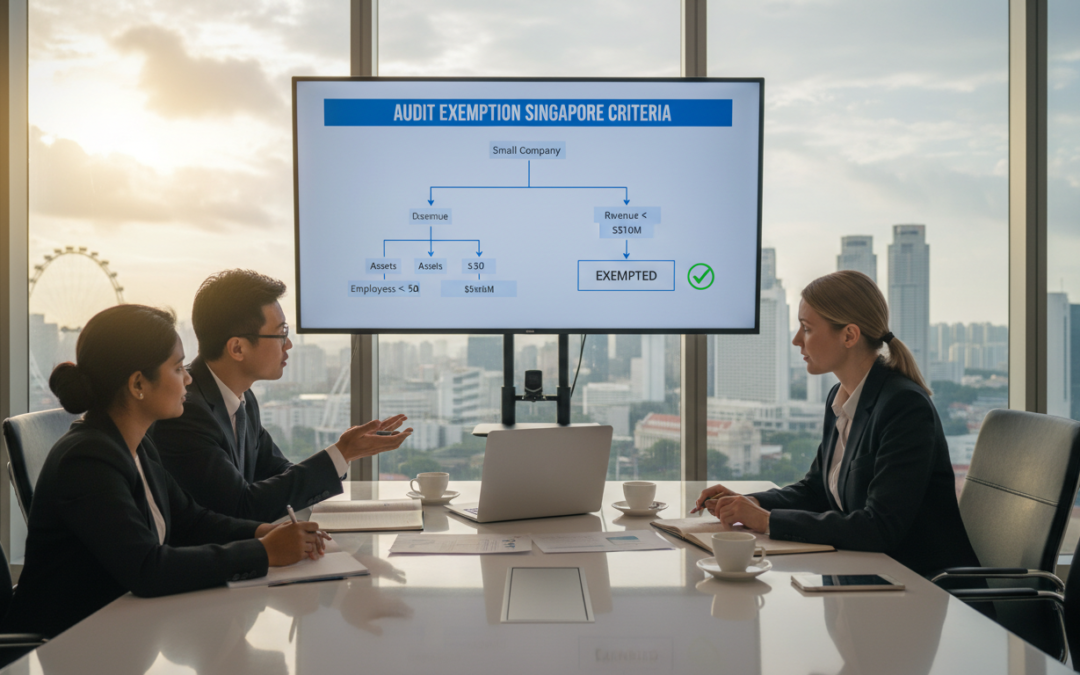
Nearly 70% of small private companies could meet the rules that remove the statutory audit need for financial years starting on or after 1 July 2015.
This guide exists to help Singapore-incorporated businesses apply the test correctly and avoid filing mistakes with ACRA. It does not remove the duty to prepare compliant financial statements, keep records, or meet annual filing deadlines.
We walk through a simple flow: confirm private company status, test thresholds for revenue, assets and employee headcount, apply the two-year rule, then cover group and new-company scenarios. The law uses a “2 out of 3” rule so that size is measured fairly across measures.
Who benefits most? Small and medium enterprises that want to reduce compliance cost while staying fully compliant under the Companies Act. Note the practical risk: a wrong declaration can trigger ACRA scrutiny, so directors should document the eligibility check each year and know when an audit is still required.
Key Takeaways
- Check private company status first before claiming the relief.
- Use the three thresholds — revenue, assets, staff — and the 2-out-of-3 rule.
- Keep proper records and financial statements even when no audit is needed.
- Document yearly eligibility checks to reduce regulatory risk.
- Special rules apply for groups and newly incorporated companies.
- Understand when an audit remains mandatory so you do not assume size guarantees relief.
What audit exemption means for Singapore companies today
When a company qualifies, directors may present unaudited financial statements for that financial year. This change removes the statutory need to appoint an auditor for the qualifying year, which saves time and cost for many small private firms.
What the change removes — and what it does not remove
The main practical shift is simple: no statutory audit and no mandatory auditor appointment for that year. However, it does not remove the duty to prepare proper statements or keep accounting records.
“Unaudited accounts still require the same standards of preparation and supporting records as audited accounts.”
- Year-end close and preparation of financial statements remain mandatory.
- Annual Return filing with ACRA and corporate tax filings with IRAS still apply.
- Directors must keep reliable accounting records and meet governance requirements.
When the small company concept took effect
The legal relief applies to financial years beginning on or after 1 Jul 2015. Companies must test eligibility each year. Being exempt this year does not guarantee the same status next year if the business grows or restructures.
| Aspect | Removed for qualifying year | Still required |
|---|---|---|
| Statutory audit | No auditor appointment required | Prepare unaudited financial statements |
| Records | Independent review not mandated | Maintain accounting records and supporting documents |
| Filings | Audit report not submitted | Annual Return and corporate tax filings remain due |
For practical guidance on related filing obligations and service terms, see the terms and conditions.
Audit exemption Singapore criteria under the small company concept
Begin with the gateway test. The company must be a private company for the financial year you are assessing. If it ceases to be private during that year, the company must not rely on the relief for that year.
Private company requirement for the financial year in question
The legal status check is binary: private or not. Directors should document the company’s status at year end as part of the file that supports the eligibility conclusion.
Meeting at least two quantitative thresholds
The size test asks that the company meets at least two of three thresholds for the immediate past two consecutive financial years. This 2-out-of-3 approach reflects different business models — service firms may be low on assets but higher on revenue, while traders show the reverse.
Total annual revenue threshold and what counts as revenue
Total annual revenue must be ≤ S$10m. Use the figure labelled total revenue in your financial statements. Do not substitute informal management figures; use amounts recognised under the applicable accounting standards.
Total assets threshold and where to find it in your financial statements
Total assets must be ≤ S$10m. Locate this on the statement of financial position (balance sheet) as the total assets line used in the company’s financial statements for the year.
Employee headcount threshold and how to measure it
The employee test is a headcount of full-time employees at the end of the financial year. Directors should record the number and keep a simple worksheet showing revenue, total assets and employees for each year. Tick off which two thresholds the company meets to confirm whether the company qualifies as a small company.
If the company qualifies, directors may prepare unaudited financial statements and declare the status in the Annual Return, subject to group rules and exceptions. Note: a private company with corporate shareholders can still qualify if the thresholds are met.
How to check the two consecutive financial years test correctly
Start by fixing the two-year reference window to check whether past performance meets the small company thresholds.
What “immediate past two consecutive financial years” means
Use the two financial years that end immediately before the year you assess. For example, for FY2026 eligibility, examine FY2025 and FY2024 based on your year‑end dates.
Worked logic to decide if your company qualifies this year
- Confirm the company remains private in the current financial year.
- For each of the past two consecutive financial years, check if at least two of the three thresholds were met (revenue, total assets, headcount).
- If both years meet the 2-of-3 test, the company qualifies as a small company for the current year.
Example: Year A and Year B both show revenue ≤ S$10m and headcount under the limit. The test is met. If Year A meets two thresholds but Year B meets only one, the company does not qualify.
Ongoing qualification and disqualification
Once a company qualifies, it keeps that status until disqualified. Disqualification happens if the company ceases to be private during a year, or if the past two consecutive financial years no longer meet the two-out-of-three requirements.
| Step | What to check | Result |
|---|---|---|
| 1 | Confirm private company status in current year | Proceed only if private |
| 2 | Verify two thresholds met in Year 1 | Pass or Fail |
| 3 | Verify two thresholds met in Year 2 | Pass or Fail |
| 4 | Board note recording calculations | Retain as evidence |
If your company is part of a group: applying the small group rules
Group membership changes how the size test is applied and adds a consolidated assessment alongside the company-level check.
Two-layer test for company and group
The company must qualify as a small company on its own. And the entire group must qualify as a small group on a consolidated basis for the same assessment period.
Consolidated thresholds and measurement
On a consolidated basis the group must meet at least two of three limits for the immediate past two consecutive financial years:
- Revenue ≤ S$10m
- Total assets ≤ S$10m
- Employees ≤ 50
These remain the 2-out-of-3 requirements applied to the group totals.
How to determine consolidated figures
If consolidated accounts exist, use the consolidated total revenue and consolidated total assets from those statements made under applicable standards.
If no consolidated accounts are prepared, aggregate each group member’s revenue and assets, and sum employee numbers across the group. Include foreign members when forming the consolidated basis.
Common outcome and practical note
A subsidiary may qualify as a small company but the entire group might not qualify as a small group. In that scenario the subsidiary generally cannot claim the audit exemption.
| Test layer | What to use | Typical result |
|---|---|---|
| Entity-level | Standalone revenue, assets, employees | Company may qualify small company |
| Group-level | Consolidated basis totals (all members) | Entire group must meet 2-of-3 to qualify small group |
| No consolidated accounts | Aggregate members’ figures including foreign entities | Use aggregated totals to test group must pass |
Newly incorporated and transitional cases: how eligibility works after incorporation
Start‑ups often ask how to assess size limits when they lack two prior sets of accounts.
Companies incorporated on or after 1 Jul 2015
If your company started on or after 1 Jul 2015 and is a private company, it may qualify small company status in its first or second financial year after incorporation.
Directors should test the three limits for the relevant financial year and confirm that at least two are met. If the company does not qualify in the first year, it has a second‑year opportunity to meet the thresholds. This is useful where early costs or irregular revenue distort the first year’s figures.
Transitional provisions for companies incorporated before 1 Jul 2015
For companies formed before 1 Jul 2015, eligibility can be established if the company is private and meets the thresholds in the first or second financial year commencing on or after 1 Jul 2015.
Practical note: always align the assessment with your company’s financial year start date, not the calendar year, to avoid testing the wrong years.
| Scenario | Which years to test | Practical outcome |
|---|---|---|
| Incorporated on/after 1 Jul 2015 | First or second financial year after incorporation | May qualify small company if two limits met |
| Incorporated before 1 Jul 2015 | First or second financial year commencing on/after 1 Jul 2015 | Transitional test allows qualification if limits met |
| Did not meet in year 1 | Test year 2 | Second chance to qualify small company |
Next step: once eligibility is established for the relevant year, prepare unaudited financial statements and declare the status in the Annual Return, subject to the usual exceptions.
How to declare audit-exempt status and complete annual filings with ACRA
Directors should finalise eligibility checks well before year‑end so that revenue, total assets and employee counts can be validated and documented in time.
Confirm eligibility before year‑end close
Run a simple checklist: confirm private company status for the year, verify the two‑of‑three thresholds for the two relevant years, and check group consolidation where applicable.
Prepare unaudited financial statements under applicable accounting standards
Unaudited financial statements must be full, compliant statements with reconciliations and supporting schedules — not informal summaries. Ensure total revenue and total assets used for the test match the totals in the statements prepared under your accounting framework.
Declare status when filing the Annual Return
No prior approval from ACRA is required. Companies assess eligibility and make the declaration during the Annual Return filing. Keep director sign‑offs, supporting worksheets and governance notes on file in case of queries.
“Resolve borderline classification issues — such as revenue recognition or headcount definition — before you file, not after.”
For more details on the small company concept, see the small company concept.
When audit exemption does not apply (even if you are small)
Even compact companies must prepare for situations that force formal scrutiny of their accounts. Directors should understand the triggers that remove the practical benefit of not appointing an auditor.
Losing relief through disqualification over consecutive financial years
Growth, a reorganisation, or becoming non‑private at any time in a year can disqualify a small company. The rule uses the two consecutive financial years test, so changes may affect eligibility only after the reference window is applied.
Shareholders may require an auditor
Shareholders holding at least 5% of voting rights can demand that the company appoint an auditor. Notice must be given in writing at least 14 days before the year end, so monitor shareholder communications closely.
Public interest, regulator or court directions
Certain public interest or regulated entities must be examined regardless of size. The regulator, a liquidator, or the court can also direct a formal review when concerns arise.
Voluntary audits: a strategic choice
Many firms choose a voluntary audit to satisfy lenders, investors or governance needs. Weigh the cost against benefits like easier fundraising, stronger credit terms and improved stakeholder confidence.
Practical tip: if you expect to lose relief, start auditor discussions early to avoid filing delays and ensure smooth transition to audited statements.
Conclusion
A concise decision path helps directors turn thresholds and dates into a reliable yearly process.
Confirm private company status, test the two‑of‑three thresholds for the immediate past two consecutive financial years, and record the results. This simple flow is the core of qualifying as a small company under the reform that took effect for financial years starting on or after 1 Jul 2015.
Where a company sits in a group, check the group position too; the relief only applies if both the entity and the group qualify. Keep a signed board note and worksheets each year as evidence of the assessment.
The audit exemption removes the statutory requirement for an auditor, but it does not remove obligations to prepare accurate financial statements, keep records or meet filing duties. If figures sit close to limits, seek professional help to avoid misinterpretation of the criteria and reporting requirements.
For practical walkthroughs, see this audit exemption guide and consider specialist company secretary services when needed. Used correctly, the relief can lower compliance cost while keeping the company fully compliant.
FAQ
What does audit exemption remove and what obligations remain?
When did the small company concept take effect in Singapore?
What are the private company requirements for the relevant financial year?
Which two quantitative thresholds must be met to qualify as small?
What counts towards the total annual revenue threshold?
Where do I find total assets in the financial statements and what is included?
How is employee headcount measured for the threshold?
What does “immediate past two consecutive financial years” mean in practice?
How do I decide whether the company qualifies this year using worked logic?
How does ongoing qualification work until disqualification?
When must a company qualify on both a standalone and group basis?
What are the consolidated basis thresholds for revenue, assets and employees?
How do you determine consolidated figures if consolidated accounts are not prepared?
What happens when a subsidiary qualifies but the entire group does not?
How are newly incorporated companies treated for eligibility?
What are the transitional provisions for companies incorporated before July 2015?
When should you confirm eligibility before year-end close?
What needs to be prepared if you choose unaudited financial statements?
How do you declare audit‑exempt status when filing the Annual Return with ACRA?
When does the waiver not apply even if the company is small?
Can shareholders force an independent examination despite qualifying as small?
Are there situations where a voluntary independent examination is advisable?

Dean Cheong is a Singapore-based commercial growth architect and CEO of VOffice, known for helping B2B companies turn fragmented sales efforts into predictable revenue systems. He specializes in sales process optimisation, CRM-driven visibility, and market entry strategy, combining execution discipline with a strong academic grounding in business banking and finance from Nanyang Technological University. His focus is on building repeatable, data-backed growth frameworks that companies can scale with confidence.